

18 Fruean Way, South Yarmouth, MA 02664 508-694-7734 · info@capegraniteconnection.com
Cape Granite Connection

Caring for your countertop

The questions we hear most after an install are about care — what cleaner is safe, whether a hot pan will hurt the stone, when to reseal. Here's the honest version, material by material. It's less work than most people fear.

Trivetsunder every hot pan — even on granite, it's cheap insurance
Soapmild dish soap and warm water clean every stone we sell
Boardscut on a board — the stone wins against your knives every time
Fastwipe wine, coffee and oil sooner rather than later

Quartz

Engineered quartz is non-porous — it never needs sealing, and coffee, wine and oil wipe straight off. Its one weak point is heat: the resin that binds the stone scorches around 300 °F, and a pan straight off the burner leaves a permanent whitish ring. A trivet solves it entirely.
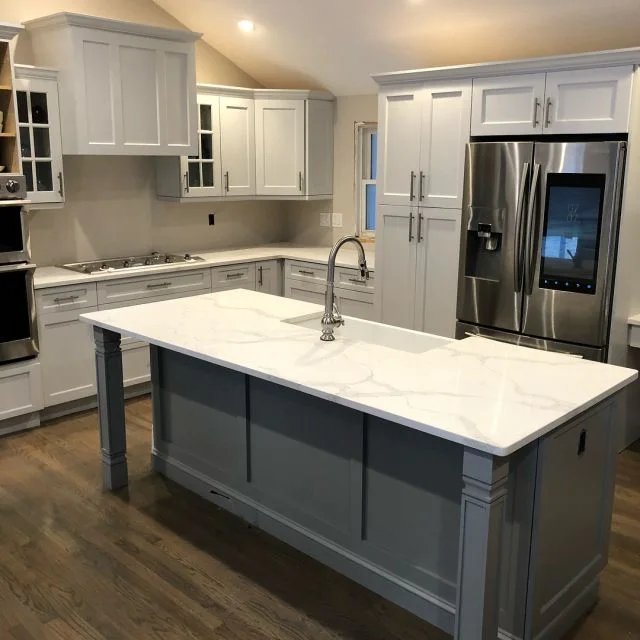
Calacatta-veined quartz island on a grey base in a tall white kitchen — quartz needs no sealing, just a trivet

Do

Clean with dish soap and warm water on a soft sponge or cloth. Lift dried-on gunk with a plastic scraper. Use trivets and hot pads without exception.

Don't

No hot pans on the surface. No bleach, oven cleaner, abrasive powders or scouring pads — they dull the finish. And no quartz outdoors: UV yellows the resin, which is why our outdoor kitchens are granite.

Outdoor kitchen under a pergola with a black granite counter on a natural stone base
Outdoors is granite territory — UV yellows quartz resin, so this pergola bar is black granite on fieldstone.

Granite

Granite is the low-drama workhorse: hard, heat-tolerant and happy for decades if the sealer is kept up. We seal every top at install; plan on resealing every one to three years depending on the stone and how hard the kitchen works. The test is simple — drop a little water on the counter, and if it darkens within a few minutes instead of beading, it's time.
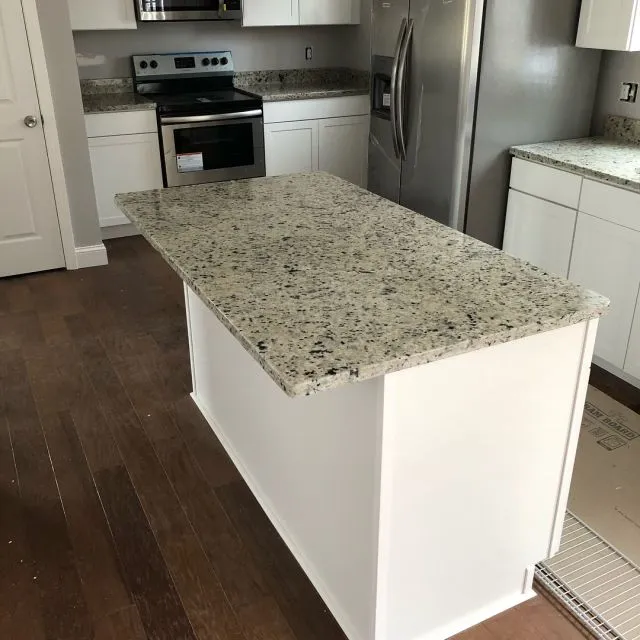
White speckled granite island and matching perimeter counters with stainless appliances, installed on Cape Cod

Do

Dish soap and water, or a pH-neutral stone cleaner. Reseal when the water test says so — or have us do it. For a set-in stain, a baking-soda poultice under plastic wrap overnight usually draws it out.

Don't

Skip vinegar, lemon, bleach and ammonia cleaners — they won't dissolve the granite, but they eat the sealer that protects it. Trivets are still smart: sudden extreme heat can shock any natural stone.

Quartzite

Quartzite gives you marble looks with near-granite hardness — but it's still a porous natural stone, and some varieties drink more than others. Denser slabs go a couple of years between sealings; softer ones want it yearly. One honest warning: some stones sold as "quartzite" are really marble or dolomite and will etch like marble. We'll tell you which is which while you're standing in front of the slab.
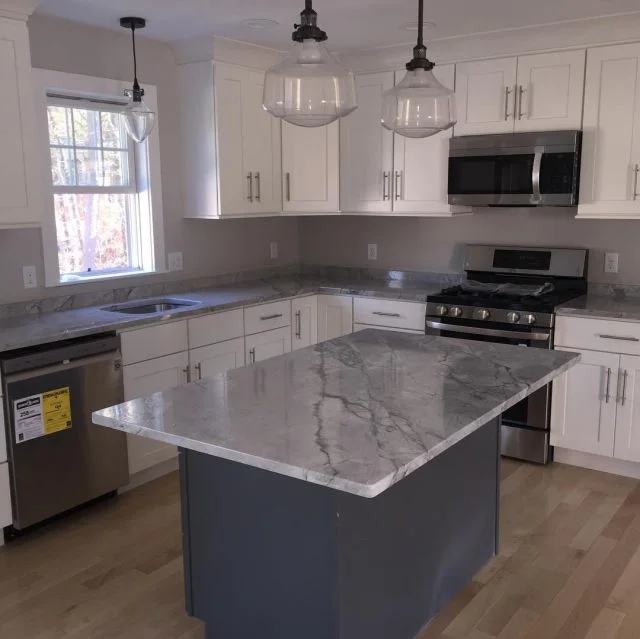
White kitchen with a light grey quartzite island and glass pendants — quartzite reads like marble but wears closer to granite

Do

Treat it like granite: mild soap or pH-neutral cleaner, trivets, and the water-drop test a couple of times a year to know when sealer is due.

Don't

Don't assume every white "quartzite" shrugs off lemon juice — verify the stone first. And don't let oil sit near the cooktop; oil stains are the slowest ones to draw back out.

Marble

Marble is calcite, and acids react with calcite — lemon, wine, vinegar and tomato leave dull "etch" marks that no sealer can prevent. Sealer stops stains from soaking in; etching is a chemistry problem, not a sealing problem. That's why we'll honestly steer marble toward vanities, fireplaces and baking stations, and suggest quartz for a hardworking family kitchen.
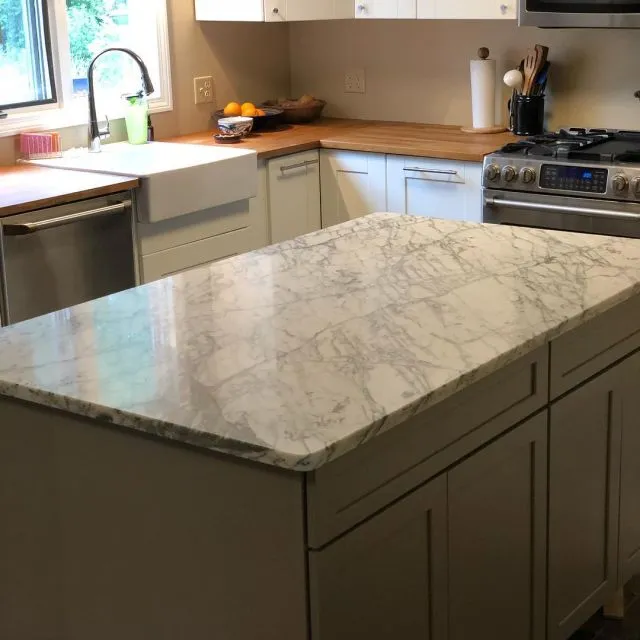
Kitchen island with Carrara-style grey veining, farmhouse sink and butcher-block perimeter counters

Do

Wipe spills right away, use a cutting board always, clean with pH-neutral stone cleaner only, and reseal about once a year. A honed finish hides everyday wear better than a polished one.

Don't

No acidic or abrasive cleaners, ever — that includes vinegar "natural" sprays. Don't panic over an etch mark either: a pro can re-hone or re-polish the spot. We do that.

We reseal and repair, too

Resealing, re-polishing, chip and seam repair — including stone we didn't install. If your counter fails the water test or a corner took a hit, call us before it becomes a bigger job.

Book a resealing or repair508-694-7734

Questions we get every week

Can I put a hot pan straight on a quartz countertop?
No — and this is the one quartz rule that really matters. The resin that binds engineered quartz starts to scorch around 300 °F, and a pan off the burner or out of the oven is well past that. The mark it leaves is a permanent whitish or yellowed ring, not something that polishes out. Keep a trivet by the stove and quartz is nearly indestructible otherwise.
What should I clean my countertop with day to day?
Mild dish soap, warm water and a soft cloth — that's the answer for every stone we sell, quartz included. If you want a spray, pick one labeled pH-neutral or stone-safe. What to avoid: bleach, ammonia, vinegar, oven cleaner and abrasive powders. On quartz they dull the finish; on granite, quartzite and marble they eat the sealer — or the stone itself.
How often does granite need sealing, and how do I know it's time?
Every one to three years for most granite, six months to two years for quartzite, and about yearly for marble — but the water test beats the calendar: drop a little water on the counter and wait a few minutes. If it beads, the sealer is working; if the stone darkens, it's time. We reseal countertops all over the Cape, including tops we didn't install.
There's a dull spot on my marble where lemon juice sat. Is it stained?
That's an etch, not a stain — the acid reacted with the calcite and ate the polish off the surface. No sealer prevents it, which is why we're honest about where marble belongs. The good news: an etch is repairable. We can re-hone or re-polish the spot so it disappears back into the finish.
Can I cut directly on the stone?
Granite and quartzite won't be hurt by your knife — but your knife will be, fast. Quartz can actually scratch if you saw at it hard enough. Either way the answer is a cutting board: it protects the edge of your knives and keeps the countertop's finish uniform for the long haul.
How do I get a stain out of granite or quartzite?
Make a poultice: baking soda mixed with water into a peanut-butter paste (for oil stains, use a little dish soap in the mix), spread it over the stain, cover with plastic wrap, and leave it 24 hours before wiping and rinsing. Stubborn stains can take a couple of rounds. If it won't budge, call us before trying anything harsher.
Do you reseal or repair countertops you didn't install?
Yes. Resealing, re-polishing, chip repair and seam repair on existing stone are regular work for us, whoever installed it. If your counter fails the water test or picked up a chip, call 508-694-7734 and we'll take a look.